



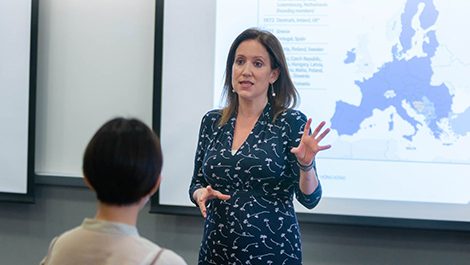
Durham, England (PhD 2022) Assistant Professor and Co-Director of the LLM Programmes Co-Director of the Durham International Dispute Resolution Institute (DIDRI) Durham Law School, Durham University
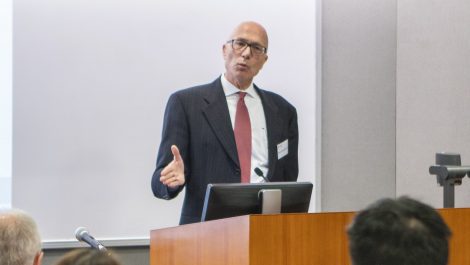
Dr. Can Eken has published his book, Third-Party Funding in Investment Arbitration (Springer), which is based on his PhD thesis at CUHK LAW. The book provides a comprehensive analysis of third-party funding (TPF) in investment arbitration, examining its legal, procedural, and ethical implications. By assessing key case law, international instruments, and jurisdictional approaches, the book offers insights into the future of TPF in investment arbitration and its impact on global dispute resolution. Importantly, the book proposes the best practice guideline for funders operating in the investment arbitration regime. Dr Ekan spoke at CUHK LAW about his book on 31 March 2025. Its details are available here.
Hong Kong (JD 2023) Director, Perun Consultants Limited
“Since my part-time JD studies at CUHK LAW last year, I transitioned in January 2025 into a new role as Director at Perun Consultants Limited, specialising in insolvency and forensic work. In the same month, I completed the INSOL Future Leaders Program in Hong Kong, which deals with cross-border insolvency and restructuring. Taking Private International Law at CUHK has meaningfully inspired me to tackle real-world cross-border issues. I am also now helping with alumni events at my undergraduate university as one of its committee members and mentors. My new firm presents me with many exciting and challenging engagements. I enjoy challenges, and fortunately CUHK LAW has a strong network of alumni who are eager to help each other.”
Shanghai (JD 2008) Partner, Wintell & Co
“I want to share one of my article (titled “Strategic of Interim Measures in Arbitration”) that had been reposted in some law issues and internal briefing in judicial system.
The interim measures, including but not limited to “freeze” the bank account of the counter party, are quite frequently used in arbitrations and litigations. Unlike that in the textbook, the interim measures are somehow regarded as one of the most crucial step in whole procedure of dispute resolution, and is deemed as particularly important in securing enforcement of an arbitration. I usually contrast international arbitration practices in China—where courts handle property, evidence, and behavior preservation—with international procedures influenced by common law traditions. I have noted that PRC parties face challenges when common law arbitrators prioritize tribunal-issued interim measures over court enforcement, leading to difficulties in enforcing such measures within China.
Key considerations include jurisdictional variances, the UNCITRAL Model Law’s shift toward allowing tribunals to grant interim measures upon application, and the burden of proof regarding what is “irreparable harm.” I also highlight tactical approaches, such as countering interim measure requests by disputing the likelihood of success on substantive grounds. The article is used to help the practitioners to adapt strategies, understand tribunal biases, and navigate evidentiary complexities to avoid disadvantages in international arbitration.
The article can be accessed here.”
Singapore (PCLL 2013) Head of APAC Legal and Regulatory Affairs, Houlihan Lokey (NYSE: HLI)
Roy is Head of APAC Legal and Regulatory Affairs at Houlihan Lokey (NYSE: HLI). He manages teams that provide legal advisory, secretarial, compliance, regulatory, data privacy and protection, transaction management and documentation support to businesses in Houlihan Lokey, primarily focusing on financial valuations, corporate finance and restructuring.
Roy is an experienced private banking and investment banking legal specialist working in the APAC banking industry. He was an executive director at Goldman Sachs focusing on private wealth management and lending before moving to Houlihan Lokey to head up the firm’s legal and compliance team in APAC. He is based in Singapore with regional oversight over Hong Kong, China, Singapore, India, Australia and Japan.
Before his career in the financial services industry, he was a legal practitioner of cross border international banking, restructuring transactions and corporate finance transactions in leading international White Shoe and Magic-Circle law firms including Latham & Watkins, Allen & Overy, and Gibson Dunn & Crutcher in major global financial hubs including Hong Kong, New York, London and Singapore.
Roy was called to the Hong Kong, Singapore and New York bars.
Roy graduated with Bachelor of Laws (First Class Hons) from King’s College London, UK. He further received his Postgraduate Certificate in Laws (PCLL) (Dean’s List) from The Chinese University of Hong Kong and his Master of Laws (LL.M.) (Harlan Fiske Stone Scholar) from Columbia Law School, New York.
In this edition of our Newsletter Roy shares the following:
“I was recently invited to speak at the APAC Legal Congress 2025 as an expert panelist on the topic, ‘How important is the role of in-house counsel in fighting cyber-crime?’ In a world where cyber threats are escalating in frequency and sophistication, in-house counsel now serve as key strategists in cybersecurity risk management, regulatory compliance and incident response. The discussion explored the evolving responsibilities of in-house legal teams in preventing, mitigating and responding to cyber threats. The panelists also spoke about how they collaborate with IT and security teams to ensure compliance with data protection laws and manage the legal and repetitional risks associated with cyber breaches. The attendees gained insights into best practices for cyber risk governance, emerging regulatory trends, and the Congress helped equip them with the knowledge and tools needed to play a proactive and strategic role in defending their organisations against cyber crime.”
Hong Kong (LLB 2012, PCLL 2013) Funds Lawyer / Founder, Willa Legal
“I had a wonderful experience teaching at the Peking University Law School, delivering a lecture on Hong Kong Securities Regulation and Crime alongside my fantastic and highly experienced co-lecturer, Albert da Rosa.
During the lecture, we explored both the law and practical applications, discussing how Hong Kong’s robust rule of law, securities regulation and financial law development have propelled its status as an international financial centre. I was genuinely delighted to see PRC law students’ strong interest in Hong Kong law and the common law system.
To assess the cohort’s understanding, we conducted a quiz after the lecture. Just for fun, I challenged two popular AI models – Deepseek and GPT4 – to tackle the same questions.
Here are the fascinating results: – Deepseek scored: 60%. – GPT-4 achieved: 78%. – Our remarkable PKU law students earned a median score of 76% and the top of the class scored 97%.
I was truly impressed by the cohort’s engagement, curiosity, and sharp analytical skills.
We were even treated to an unexpected yet beautiful snowfall in Beijing – yes, snow in March!”
|